Question: What are the best places to visit in Butwal?
Most travelers pass through Butwal on the way to somewhere else: Lumbini to the south, Pokhara or Tansen to the north, or the Indian border at Sunauli. That is a shame, because Nepal’s busy trading city at the foot of the Chure hills has more to offer than a bus change. Within a few kilometers you can walk through the ruins of a 16th-century royal palace, stand on the site of a famous battle against the East India Company, ride two different cable cars into the hills and visit one of the region’s most popular Shiva temples.
Butwal sits where the East-West (Mahendra) Highway meets the Siddhartha Highway, on the banks of the Tinau River. It has been a trading point between the hills and the plains for centuries, and today it is a sub-metropolitan city of around 195,000 people. Here are the places worth your time, starting in the city and working outward.
Top places to visit in Butwal at a glance
- Manimukunda Sen Park (Phulbari): palace ruins and gardens
- Jitgadhi Fort: site of a famous Nepali victory in the Anglo-Nepal War
- Batauli Bazaar: the old town where Butwal began
- Lumbini Cable Car: up to Basantapur hill
- Siddhartha Cable Car: up to Nuwakot Gadhi
- Siddhababa Temple: the busiest temple near the city
- Hill Park, Deepnagar: a hillside viewpoint
- Banbatika: a forest picnic area on the edge of town
Manimukunda Sen Park (Phulbari)
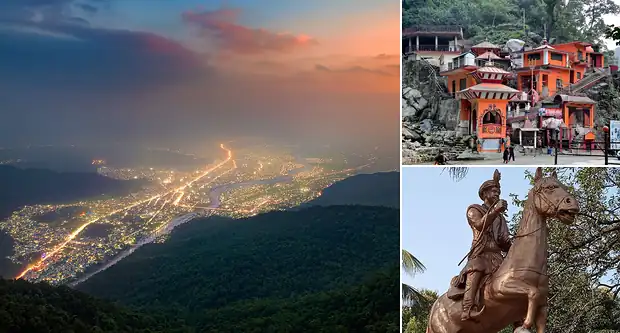
Butwal’s best-known sight is a park built around the remains of a royal palace. Manimukunda Sen, a king of the Palpa Sen dynasty, built it as his winter palace around 1518 AD, when the warm plains were more comfortable than the hills of Palpa in the cold months. Today the ruined walls sit among gardens and paths on the hillside in the western part of the city, with views over Butwal and the Tinau valley. A bronze statue of the king on horseback stands in the Phulbari area, a popular photo spot.
It is by far the most visited place in the city. Rising Nepal reported close to 700,000 visitors in the 2023/24 fiscal year, so expect crowds on weekends and public holidays. Go early in the morning on a weekday if you want it quieter.
Jitgadhi Fort
On the Tinau River stands Jitgadhi, the fort that gives Butwal its proudest story. During the Anglo-Nepal War of 1814–16, Nepali troops under Ujir Singh Thapa defeated East India Company forces here, one of the few clear Nepali victories of the war. The name itself means “fort of victory”.
The fort was restored by the Nepal Army and handed over to Butwal Sub-Metropolitan City in January 2024. A war museum has been built beside it, though reports differ on whether it is fully open, so ask locally before you go. If you are in Butwal around 20 April (Baisakh 7 in the Nepali calendar), you can catch the annual Jitgadhi Victory Festival, which commemorates the battle.
Batauli Bazaar and the city markets
Batauli Bazaar, on the west bank of the Tinau, is Butwal’s oldest settlement and the place the city takes its name from. Under the Sen kings it was a trading post where goods from the hills were exchanged for those from the plains. Walking its streets gives a sense of the older town before the highways arrived.
For a busier, more modern picture of the city, wander along Amarpath, Milan Chowk and Bhudki Chowk, the main shopping streets. They are lively in the evenings and good for street food, clothes and everyday shopping.
Lumbini Cable Car to Basantapur
Butwal has two cable cars, and they go to different places. The Lumbini Cable Car, opened in 2023 as the first in Lumbini Province, climbs about 3 km from Golpark (Bamghat) to Basantapur hill in Palpa district. The ride gives sweeping views back over Butwal and the Terai plains, and the top station has become a busy hill stop with restaurants and places to stay. On a clear day, the view across the flat plains toward India is the main reason to go.
Siddhartha Cable Car to Nuwakot Gadhi
The second cable car, running since 2024, rises about 2 km from the Deurali/Phulbari area to Nuwakot hill. At the top is Nuwakot Gadhi, an old hilltop fort area with remains from the Sen period, which was also one of the positions held by Nepali forces in 1814. It is now developing as a hill station, and it pairs naturally with a morning at Manimukunda Sen Park below.
If you only have time for one cable car, choose by what you want at the top: views and restaurants at Basantapur, or history at Nuwakot.
Siddhababa Temple
A short drive north of the city, at Dobhan on the Siddhartha Highway, Siddhababa Temple is dedicated to Lord Shiva and draws a steady stream of devotees, especially on Saturdays and Mondays. On Mahashivaratri the crowds are enormous: more than 40,000 people visited in 2025. Teej is also very busy.
Strictly speaking, the temple is just outside Butwal, in Palpa district. The road along this stretch is narrow and prone to landslides, particularly in the monsoon, so take care and check conditions before you travel. A new road tunnel under construction aims to bypass the most dangerous section.
Hill Park and Banbatika
For a quieter outing, Hill Park in Deepnagar, in the northeast of the city, is a hillside park with views over Butwal. Banbatika, in the Shankarnagar Community Forest in neighboring Tilottama, is a forest picnic area popular with local families, especially in winter.
For fossil enthusiasts: the Tinau River
An unusual footnote: the banks of the Tinau near Butwal are a known fossil site. In 1983, the journal Nature reported a fossil ape tooth from the Tinau Khola estimated at around 9 million years old. There is nothing to visit as such, but it is a good story to know as you cross the river.
Day trips from Butwal
Butwal makes a convenient, less touristy base for some of Nepal’s most important sites:
- Devdaha (around 15 km east): the home of the Buddha’s mother, Maya Devi, and the ancient Koliya kingdom. Archaeological work here is ongoing.
- Lumbini (about an hour by road): the birthplace of the Buddha and a UNESCO World Heritage Site since 1997, with the Maya Devi Temple, the Ashoka Pillar and dozens of international monasteries. Allow a full day.
- Tilaurakot (Kapilavastu): the remains of the ancient city where the Buddha grew up. It combines well with Lumbini on a long day.
- Ramagrama Stupa: believed to be the only original Buddha relic stupa never opened, on UNESCO’s tentative list.
- Tansen (roughly 1.5–2.5 hours north): a charming hill town in Palpa with old Newar houses and views of the Himalaya. With an early start you can continue to Rani Mahal, a 19th-century palace on the Kali Gandaki often called “Nepal’s Taj Mahal”.
Best time to visit Butwal
October to March is the most comfortable time, with dry weather and clear views from the hills. Butwal gets very hot from April to June, and the monsoon (roughly June to September) brings heavy rain and frequent landslides on the Siddhartha Highway toward Siddhababa and Tansen.
Two events are worth planning around: the Jitgadhi Victory Festival around 20 April, and the National Industrial Exhibition and Tourism Festival, held in Butwal every winter in the month of Poush (December–January), which draws large crowds to its stalls and cultural programs.
Practical tips
- Getting there: Gautam Buddha International Airport at Bhairahawa is about 25 km south. Long-distance buses connect Butwal with Kathmandu, Pokhara and the Indian border at Belahiya/Sunauli.
- How long to stay: one full day covers the city sights and a cable car; add a day each for Lumbini and Tansen.
- Check before you go: opening times and ticket prices for the cable cars and museum can change, so confirm locally or on the operators’ official pages.
Butwal will never be a quiet mountain retreat. But give it a day or two, and the city’s palace ruins, battle history, cable cars and temples make it far more than a stop on the way to Lumbini.
Image credits: Featured image combines three photos from Wikimedia Commons, cropped and resized: Evening View of Butwal from Nuwakot by [AUTHOR] ([LICENCE]); Siddhababa Temple by Rajesh Dhungana ([LICENCE]); Manimukunda Sen statue, Phulbari by [AUTHOR] ([LICENCE]). The combined image is shared under CC BY-SA 4.0.