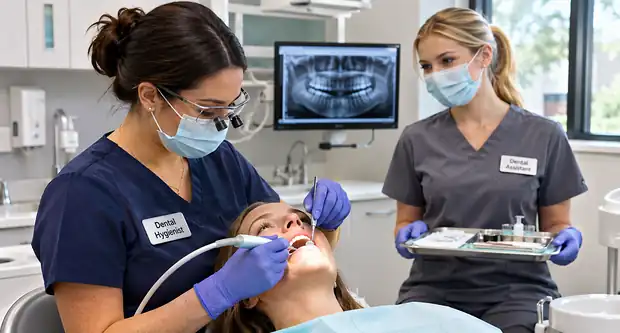
Question: What is the difference between a dental hygienist and a dental assistant?
Both work beside patients in the dental chair, both wear scrubs, and many patients could not tell you which one cleaned their teeth. But the two jobs differ a great deal in training, responsibility, licensing and pay. If you are choosing between them, here is how they compare.
The short answer
A dental hygienist is a licensed clinician who provides preventive care on their own: cleaning teeth, checking gums for disease, taking X-rays and teaching patients how to look after their mouths. A dental assistant supports the dentist during procedures and keeps the practice running, from preparing instruments to handling records. Hygienists need a degree and a state license; many assistants start with a short certificate or on-the-job training.
Side by side
| Dental hygienist | Dental assistant | |
|---|---|---|
| Main role | Preventive care and patient education | Chairside support and office tasks |
| Works on patients alone? | Yes, within state rules | Mostly assists the dentist |
| Typical education | Associate degree from an accredited program (often about 3 years with prerequisites) | Certificate (about 9 to 12 months) or on-the-job training |
| License | Required in every state (RDH) | Varies by state; some duties need certification |
| National exam | National board exam plus a clinical exam | Optional or state-required certification |
| Pay | Higher | Lower |
What a dental hygienist does
A hygienist’s appointment is their own. They review the patient’s health history, remove plaque and tartar above and below the gumline, polish teeth, measure gum pockets to check for periodontal disease, take and review X-rays, and apply fluoride or sealants. In many states they can also give local anesthesia. A large part of the job is education: explaining brushing and flossing, diet and the link between gum health and conditions such as diabetes. The dentist then does the final exam.
What a dental assistant does
An assistant’s work centers on the dentist. They seat patients, prepare and sterilize instruments, hand tools during procedures, operate suction, mix materials, take impressions, and in many states take X-rays once certified. Many also schedule appointments, update records and handle billing. In some states, assistants with extra training can take on expanded functions such as placing fillings or sealants, but their scope stays narrower than a hygienist’s.
How the training differs
Becoming a hygienist usually means completing prerequisite science courses and then an accredited dental hygiene program, most commonly an associate degree, though bachelor’s programs exist too. Graduates must pass the National Board Dental Hygiene Examination and a clinical exam before applying for a state license. The American Dental Hygienists’ Association publishes guidance on education and licensure if you want to look at the path in detail.
Dental assisting is much quicker to enter. Certificate programs at community colleges and vocational schools take about a year, and some states allow on-the-job training. Certification through the Dental Assisting National Board is optional in some states and required for certain duties in others.
How the pay compares
The longer training and the license are reflected in pay: hygienists earn considerably more than assistants, and the gap is visible from the first year. If you are weighing the extra study time against what it leads to, look at what newly licensed dental hygienists earn in your state. Pay also differs widely by location, so it is worth checking dental hygienist pay in different states and cities if you are open to moving.
Which one should you choose?
- Choose dental assisting if you want to start working within a year, prefer a supporting role, or want to test whether dentistry suits you before committing to more school.
- Choose dental hygiene if you want your own patients, more clinical responsibility and higher pay, and can commit to two to three years of study and licensing exams.
The two paths are not exclusive. Many hygienists started as assistants, using the job to gain experience and confirm their interest while completing prerequisites. If you are unsure, spending a year in a dental office as an assistant is one of the best ways to decide.