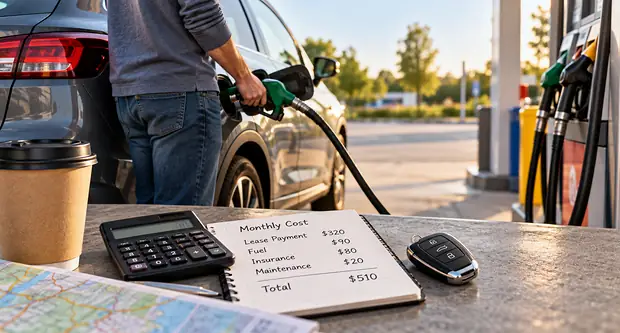
Question: What does a car lease really cost per month once you add fuel?
When people compare lease deals, they compare monthly payments. That makes sense: it is the number on the offer, and it is the one you commit to for three years. But for most drivers, fuel is the second-biggest monthly cost of having a car, and two leases with the same payment can cost very different amounts to actually drive.
How to work out the monthly fuel cost
You already know your mileage, because a lease makes you choose it: usually 10,000, 12,000 or 15,000 miles a year. That makes the sum easy. Divide your yearly miles by 12, divide that by the car’s MPG, and multiply by the price of a gallon.
Take 12,000 miles a year and gas at $3.50 a gallon. A car rated 25 MPG uses 480 gallons a year, which is about $140 a month. A car rated 40 MPG uses 300 gallons a year, about $88 a month. That is a difference of roughly $52 a month, or close to $1,900 over a 36-month lease. In other words, a lease that costs $40 a month more on paper can still be the cheaper car to have.
Use the car’s official EPA combined rating, since lease miles are a mix of town and highway driving. If you are choosing between several cars, it helps to work out what each car would cost to fuel at your own mileage before you look at the payments.
Why the fuel type matters
Some cars, especially turbocharged and luxury models, require premium gasoline. Premium costs noticeably more per gallon than regular, so a premium-only car with good MPG can cost as much to fuel as a less efficient car that runs on regular. Check the fuel requirement, not just the MPG.
Electric cars need a different sum. Divide your miles by 100, multiply by the car’s kWh per 100 miles, then by your electricity price. At 12,000 miles a year, an EV using 30 kWh per 100 miles needs about 3,600 kWh. At 15 cents per kWh charged at home, that is around $45 a month. Fast charging on the road costs more, so if you cannot charge at home, budget for a higher rate.
The true monthly cost of a lease
For each lease you are considering, add up four things: the monthly payment with the amount due at signing spread over the term; monthly fuel or charging; insurance, which varies a lot between models; and anything the lease does not cover, such as tires or maintenance after an included plan ends. Set out like that, the cheapest payment is often not the cheapest car.
How mileage and fuel are linked
If you lease 10,000 miles a year to get a lower payment but actually drive 13,000, you pay twice: once at the pump for the extra miles, and again in the excess-mileage charge at the end, often 15 to 25 cents a mile. Be honest about how much you drive, and size both the mileage allowance and your fuel budget to that number.
Three checks before you sign
First, compare official EPA ratings rather than advertising claims, so you compare like with like. Second, run the sum at a higher gas price: prices move over three years, and if the car still fits your budget at 50 cents a gallon more, you are covered. Third, think about how you drive. Mostly short trips in town favor hybrids, while mostly highway driving narrows the gap between a hybrid and a good gas car.
Summary
A lease is a fixed monthly commitment, so it pays to know the real monthly number before you sign. Add fuel to the payment, compare the totals, and the best deal is often a different car from the one with the lowest advertised price.